

In the internet age, product-market fit was a builder’s first job: find a market, then build a repeatable solution to the customer’s problem superior to their alternatives. A relatively small profession of product managers learned to do it.
AI agents are products. (Paraphrasing Marty Cagan, a product is a repeatable solution to a problem for a group of people.) The most common platforms for agents — Claude, ChatGPT, and Gemini — have all already found product-market fit as broad aids to knowledge work and are getting work done for power users by dispatching agents. Muse, Instinct, ChatGPT Dots, Grok Bot, and others have emerged in a more autonomous agentic form (thank you OpenClaw) for consumers. This is just the beginning.
More agents are coming, many more. Each will need product-market fit, but for agentic products that also depends on something more local, which I’m calling agent-impact fit. If product-market fit is “being in a good market with a product that can satisfy that market” (Andreessen), agent-impact fit is being in a workflow with an agent that can deliver the impact desired from it.
I think finding agent-impact fit could become one of the defining human disciplines of the AI era: the discipline of fitting an agent to a specific piece of work, and the work to the agent, so it delivers the desired impact.
Product-market fit was generally found once per product (though it can be lost), and millions of users adapted to it. Agent-impact fit has to be found per workflow and per institution, because the agent and the work have to adapt to each other. Given that, orders of magnitude more people will be asked to find agent-impact fit than ever found product-market fit.
Agents for most knowledge work
Most knowledge work will benefit from an agent: co-drafting memos with attorneys, supervising agent accountants, tracking patient care. That’s roughly a billion jobs,¹ from lawyers in London to agricultural extension agents in Nigeria.
The market potential is enormous, but it’s conditional. McKinsey estimates about $2.9 trillion a year of US economic value by 2030 from agents and robots, if workflows are redesigned.² That means people, often with an agent’s help, adapting both the agent and how the work gets done.
The binding constraint isn’t the model. As I wrote in Essay 6, “The Product-Model Overhang,” capability compounds while organizational learning lags model releases by 12–24 months.
Who will find agent-impact fit?
Humans with taste, skill, judgment, and drive. Not only product managers; there are too few. Worldwide, there are roughly 1 million product managers and 1 billion knowledge workers.³
For every product manager who learned to find product-market fit, about a thousand knowledge workers may need to learn to find agent-impact fit.
That’s the ceiling: every knowledge worker fitting agents to their own job. Many won’t; plenty will use agents off the shelf. But if only one in ten does it seriously (think team leads, operations managers, and domain experts who never thought of themselves as builders), that’s still 100 million people, about 100 times the PM profession.
Product-market fit was learned by a self-selected profession with a canon and apprenticeship. Agent-impact fit has to be learned by people who never signed up to be product people. They will move from asking bystander questions like “Can the AI do this?” to product questions like “What should I have AI do, how should our workflow change, and how will we know we delivered the desired outcome?”
The PM profession took a couple of decades to reach a million people. There isn’t time to repeat that at 100x, let alone 1,000x. AI transformation will demand armies.
The Agent-Impact Talent Ladder
The armies are being assembled now. In 2026 alone, AI labs and hyperscalers committed roughly $8–9 billion to deployment teams that fit agents to the work, from OpenAI’s DeployCo and Ode with Anthropic to AWS and Microsoft’s Frontier Company.⁴
Those deployment teams are just one rung of the Agent-Impact Talent Ladder.
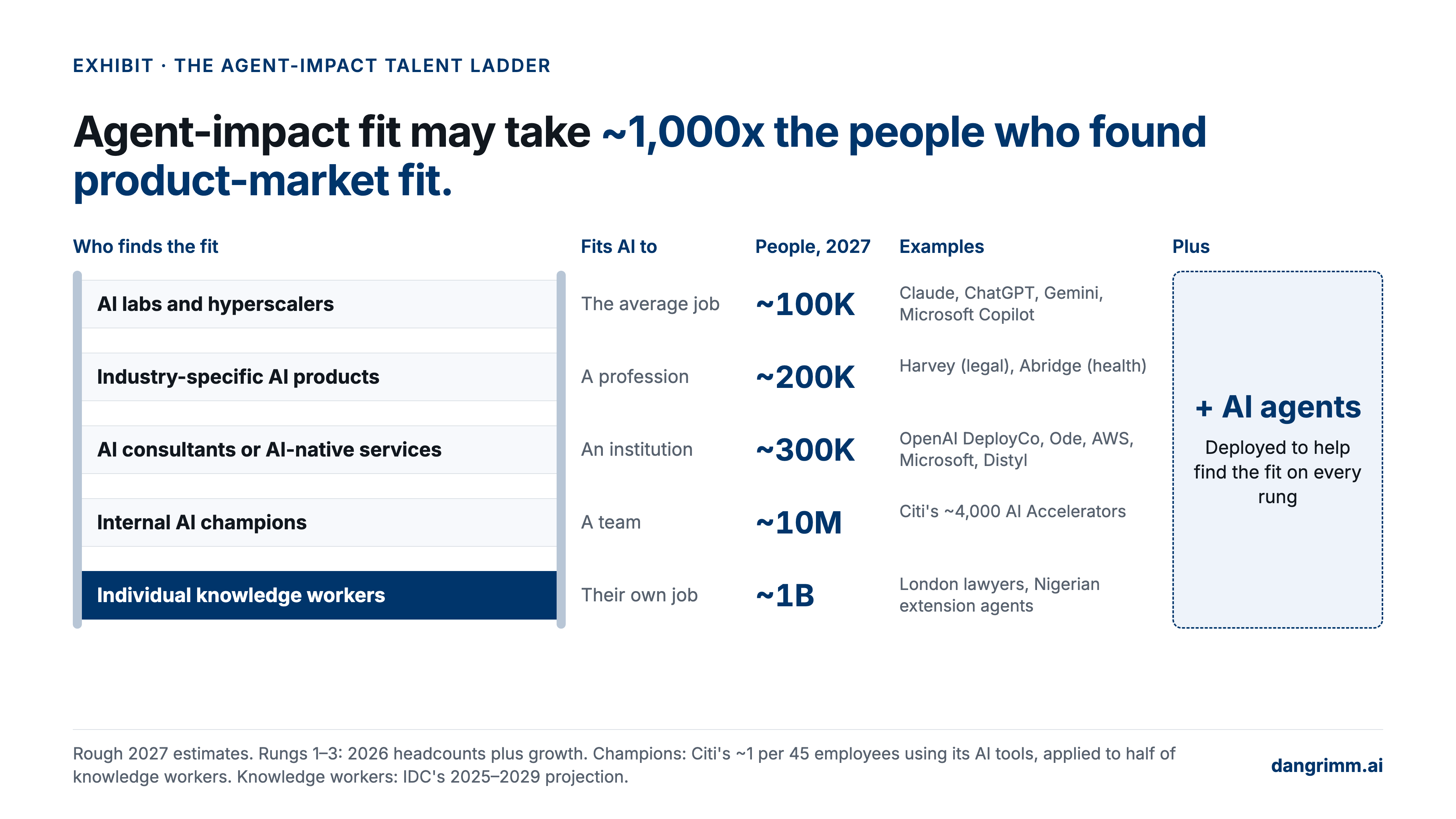
Exhibit 1. The Agent-Impact Talent Ladder. People per rung are rough 2027 estimates. The base rung counts everyone who could fit agents to their own job, not everyone who will.
The rungs compete. Each is trying to make the ones below it unnecessary: the labs want default agents good enough that industry products aren’t needed, and industry products want to fit without consultants. I doubt that happens in full. Some work will standardize around default agents, the way it did around SaaS, but someone still has to redesign the work to match. If finding fit stays local and two-sided (the workflow has to change, not just the agent), the work of finding agent-impact fit stays on the lower rungs. Those who learn to find agent-impact fit on those rungs will have options higher up the ladder. (That’s the message I recommended leaders give their teams in Essay 9, “What do you tell them?”)
AI agents are joining every rung too, studying how teams work and drafting agents to fit them. If they get good enough to find fit on their own, fewer people will need this skill, and parts of this ladder will look like punch-card operators in hindsight. But punch-card operators disappeared and the work of fitting computers to work didn’t. The spreadsheet handed it to hundreds of millions of knowledge workers. My bet is that better agents do the same: each gain in capability raises what we try to do with them, so most fit will still need people on both sides for years to come.
Finding fit is hard
In BCG’s 2026 survey of 1,330 executives, just 7.5% of organizations are leaders capturing significant value from AI while just over half lag behind. The leaders organize differently: they are 3.5 times as likely to fund a single multiyear AI program and more than three times as likely to plan their workforce around it.⁵
An Oxford trial in Nature Medicine makes the point. The model alone named the right medical condition 95% of the time. Members of the public using that same model got it right less than 35% of the time, no better than people without it.⁶ The model was right. The fit was wrong. The fix is designing the agent, and the encounter, around the people who use it or, put differently, finding agent-impact fit.
The ultimate stress test
Social impact, where I focus now, is the ultimate stress test for agent-impact fit. The user, payer, customer, and deployer are often four different entities. An agent advising farmers in Kaduna (Nigeria) contends with connectivity, technical fluency, and poverty that one in Dallas never meets. No rural clinic can afford a deployment team. There, fit has to be found at the level of a health system or extension program, often by local organizations, then carried by the health workers and extension agents who use it.
Yet these are the people with the most to gain. The world faces a projected shortfall of 11.1 million health workers by 2030.⁷ It needs 44 million more teachers, 15 million of them in sub-Saharan Africa.⁸ Nigeria has one agricultural extension agent for every 5,000 to 10,000 farmers.⁹ Where AI could matter most for human flourishing, in health, education, and livelihoods, is exactly where fit is hardest to find.
Finding fit in these markets demands generative leadership as much as engineering to imagine a better future for someone with little to give you in return. (If you’re a builder ready to deploy AI in the interest of human freedoms for those who need it most, get in touch!)
Finding agent-impact fit is a discipline
It takes judgment, across product, design, and engineering, to adapt an agent and the work around it until they fit the impact.
Leaders and laggards are running the same models. What separates them is this discipline, and unlike a model, it can’t simply be installed. The good news is that disciplines can be learned. The harder question, and the subject of the next essay, is how to learn this one fast enough.
¹ Estimates range from about 650 million to 1.2 billion, depending on the definition. The ILO (2023) counts 644–997 million jobs, 20–30% of global employment; IDC estimates 888 million in 2025, rising to 1.2 billion by 2029; Gartner has cited more than 1 billion.
² McKinsey Global Institute, “Agents, robots, and us: Skill partnerships in the age of AI,” November 25, 2025. The roughly $2.9 trillion a year by 2030 is the midpoint adoption scenario for agents and robots together, and it depends on redesigning workflows rather than individual tasks.
³ Product Focus, analyses of LinkedIn data: about 1.02 million product managers worldwide (336,000 in the US) in July 2021, and about 1.62 million (427,000 in the US) in October 2023 under broader job-title criteria. Against 0.65–1.2 billion knowledge workers, the ratio runs from roughly 400 to 1,200 to 1.
⁴ About $8.4 billion disclosed, plus undisclosed amounts from Ode’s other backers. OpenAI’s deployment company raised $4 billion from 19 investors, including TPG, Brookfield, Advent, and Bain Capital, at a $10 billion valuation; Anthropic, Blackstone, and Hellman & Friedman committed $300 million each to a new enterprise AI services company (TechCrunch, May 4, 2026, citing the Wall Street Journal for the Anthropic figures; see also Anthropic’s announcement). It launched as Ode with Anthropic on July 15, 2026. AWS committed $1 billion to a new Forward Deployed Engineering unit (The Next Web, June 30, 2026). Microsoft committed $2.5 billion to its Frontier Company, embedding 6,000 industry and engineering experts at customers (Official Microsoft Blog, July 2, 2026).
⁵ Boston Consulting Group, Applied AI Index 2026 (press release; report), September 30, 2026, survey of 1,330 CxOs and senior leaders across 20+ sectors: 7.5% future-built, 41% scaling, 47% emerging, 4.5% stagnating. Future-built companies report 2.4x the revenue growth and 2.8x the EBITDA growth of laggards; they are 3.5 times as likely to fund a single multiyear AI program (61% vs. 17%) and far more likely to practice strategic workforce planning (55% vs. 17%). BCG’s 2025 edition (“The Widening AI Value Gap,” 1,250 companies) found 5% future-built and 60% reporting minimal value.
⁶ A. M. Bean, ..., A. Mahdi, “Reliability of LLMs as medical assistants for the general public: a randomized preregistered study,” Nature Medicine 32 (2026): 609–615, published February 9, 2026. With 1,298 participants, the models alone identified the condition in 94.9% of cases; participants using them did so in fewer than 34.5%, no better than the control group.
⁷ World Health Organization, news release on the global health workforce, September 18, 2026, drawing on National health workforce accounts: health workforce levels and trends 2026. The projection covers doctors, nurses and midwives, dentists, and pharmacists; 67 countries are expected to fall short of population health needs by 2030.
⁸ UNESCO and the Teacher Task Force, Global Report on Teachers (February 2024). The 44 million figure covers primary and secondary teachers worldwide; UNESCO reaffirmed it in August 2025.
⁹ News Agency of Nigeria, “FG, IFAD, adopt AI for agricultural extension,” September 2, 2026, citing Dr Kabir Yusuf, national coordinator of the Special Agro-Industrial Processing Zones program.