

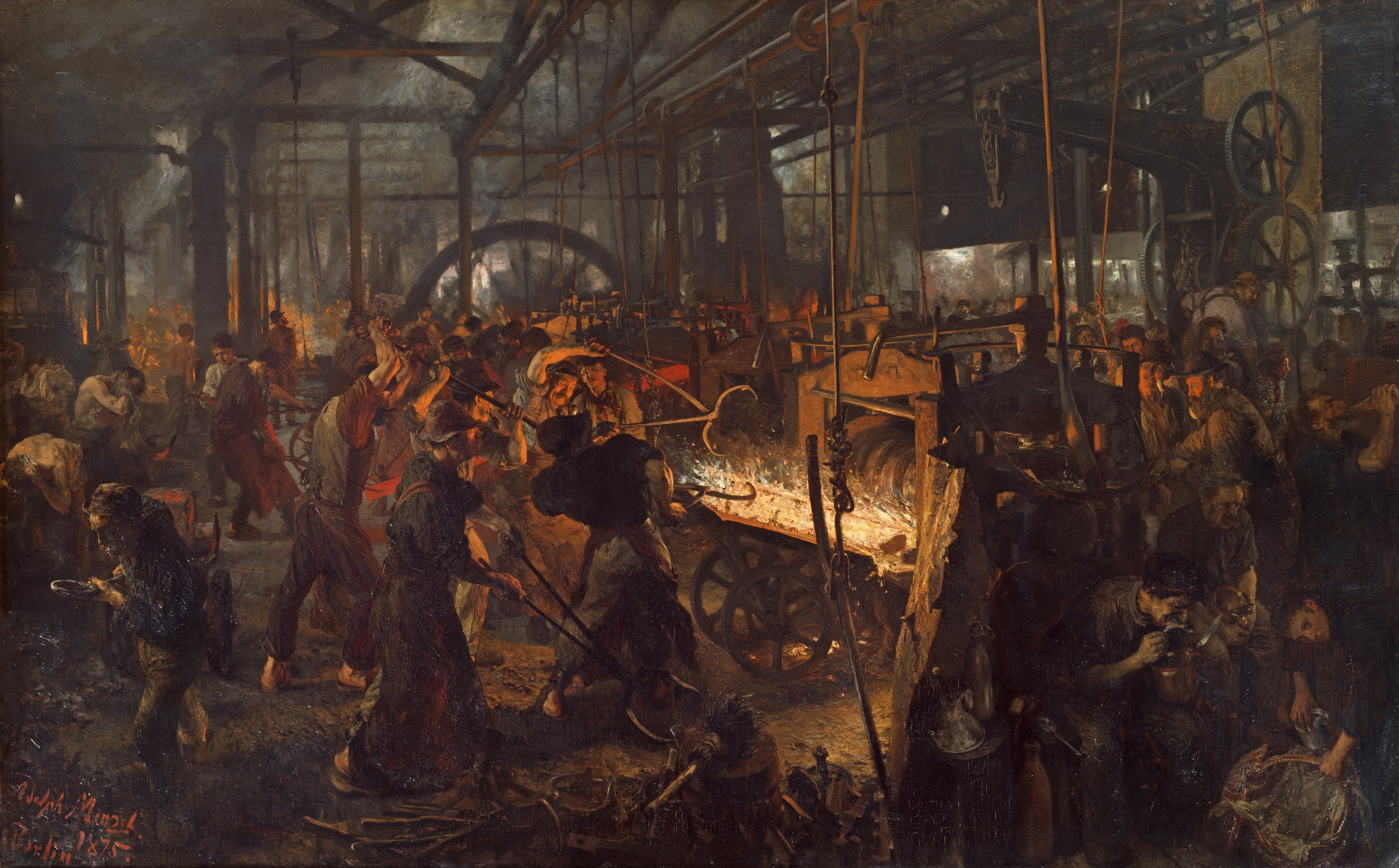
Imagine you run the Iron Rolling Mill. Every one of those men answers to you. The heat, the noise, the molten iron being wrestled through the rollers by sheer human force. You are responsible for the workers and the work: producing railroad rails.
Now walk into a modern rolling mill. Same output, but far fewer humans on the mill floor. The physical labor has shrunk dramatically from the mass of humanity Menzel painted. The workers didn’t vanish; the work shifted. Their descendants sit in climate-controlled offices, managing enterprise CRMs, adjusting marketing funnels, and hedging energy exposure.
Today, AI is transforming knowledge work. The mill emptied slowly, across generations, so no one leader ever had to stand on the floor and account for all of it at once.
You will not get that long.
It doesn’t matter if you manage a modern steelworks or a government agency or a nonprofit, AI will unlock significant impact, perhaps faster than any technology before it. The questions are yours:
How will you use AI to fulfill your organization’s purpose?
What do you tell your teams about the future?
A choice about AI impact
Here is a hypothetical to make the dilemma concrete. Let’s say you run a charity that feeds hungry children. Tomorrow, you can implement an agentic AI system that knows your organization and uses your tools as well as your best people do. Think of it as a bonus you get to spend to get more done (augment the humans) and/or reduce costs (replace the humans).
Here are three scenarios for how you spend it:
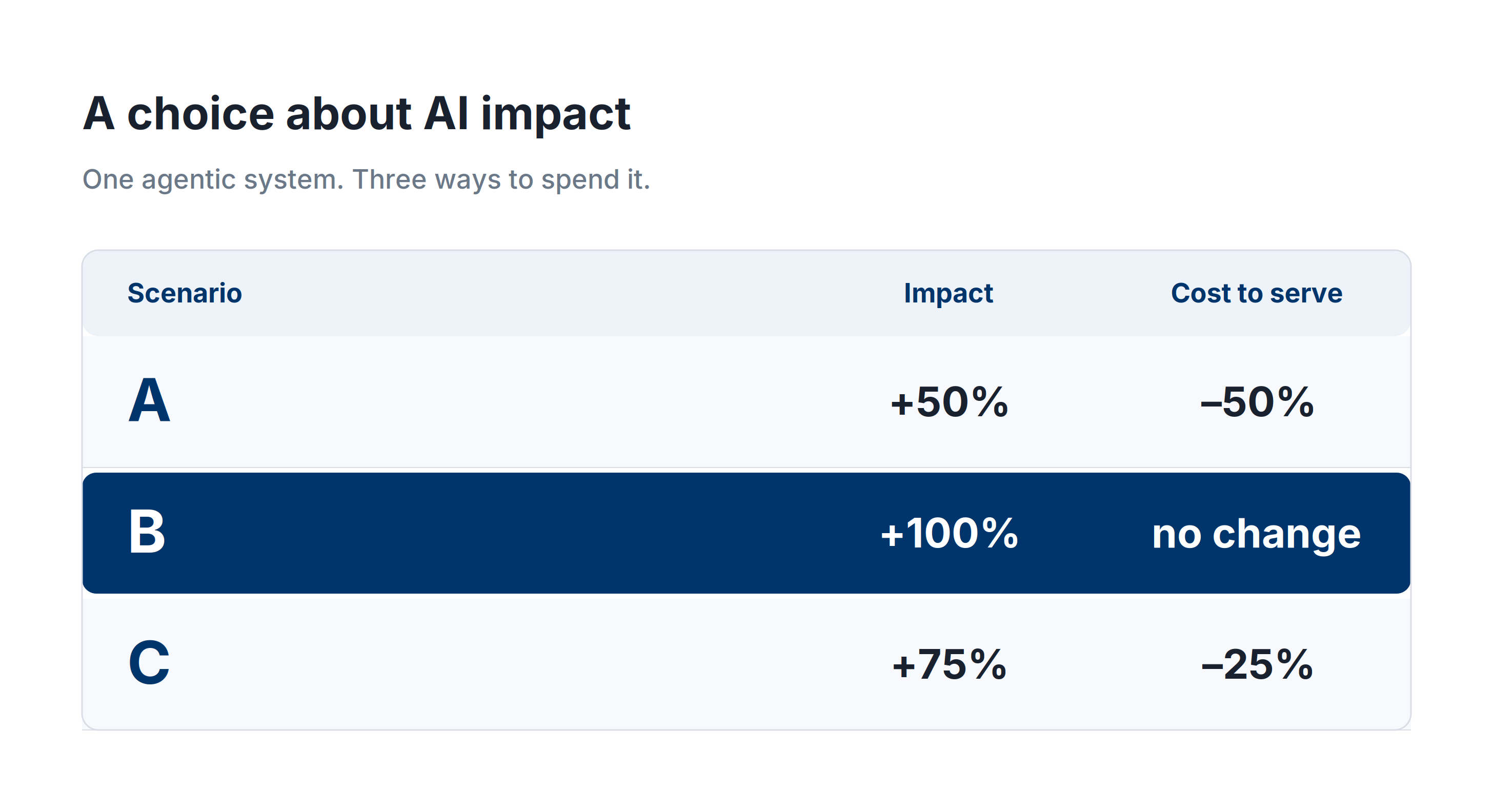
I think most of us would jump to Scenario B. Double impact and keep everyone on payroll. It’s the same for a company (more customers served, or the same served for less) or a government agency (more cases handled, or the same caseload at a lower budget). Same offer. Same easy yes to Scenario B… or is it?
What is it all for?
Earlier tools took over muscle, then routine mental tasks like arithmetic and bookkeeping. AI reaches into the thinking and judgment we assumed only a person could do. It forces us to answer three fundamental questions from first principles before picking a scenario:
What is the organization for? Every organization exists to solve a real problem for real people. Feed the hungry. Treat the sick. Keep a city running. Purpose is outside the org. The financials, whether profit, a budget, or donations, are a way you keep score. It is the test of whether you solved the problem well, not the reason the place exists. (Leaders who get that backwards read the organization through the P&L alone, stop walking the front line, and make expensive mistakes.)
What is the work for? Work has two sides. One side is the output: the thing that gets made, sent, processed, closed. A machine can often do that side. The other side is what the work gives the person doing it: a growing skill, a wage, the pride of being good at something that matters. That second side never shows up on the spreadsheet, so it looks easy to cut. But it often carries real value to the organization (great senior lawyers were trained as junior lawyers) and real meaning to the person.¹
What is the worker for? This is the one we forget. The human worker is not only an input to an output. A person is not their job, and the work is for the person, not the person for the work. So the honest test of any big change, including this one, is not only what it does to the output. It is whether it widens what our people are able to do and be now and in the future, or narrows them to the one task a machine has not reached yet… until it does.² We must not short-change workers by reducing them to their employment, but rather call them to the fullness of their potential.
Part of leading well is living in the future. We must tell these workers the truth: they must adapt in the age of AI to deliver results and thus have the opportunity to have good work, either at their current firm or a different one. As Max De Pree put it in Leadership Is an Art, a leader’s first responsibility is to define reality, and the last is to say thank you. Defining reality now means seeing what AI will do to the work before it does it.
How to play this out?
Most of us would have chosen Scenario B: double the impact and keep the team.
Realistically, I think this will be the wrong call for most organizations. The AI does not pour more of the same work into the same hands. It doubles the impact by changing the work itself. The person who wrote grant letters now checks letters the machine wrote. The person who was great at sitting with a family now runs a system that handles the intake more effectively.
This is not a thought experiment. In 2026, researchers found AI was nearly three times as effective as professional canvassers at raising real donations for Save the Children.³ Maximizing such capability demands a new process, not stapling onto the existing one.
A leader serious about this does not ask each person to do their old job with a new tool. They step back, start from the outcome they want, redesign the whole process to deliver it, and only then see which human jobs are left and what those jobs now involve. The largest gains, and the largest disruption, come from reshaping whole processes, not from handing everyone something faster.⁴ This is now the standard advice from BCG and McKinsey.⁵
The new work is different work. Doing it well means every person on your staff learning to do their job in a way they have never done it before. Some workers will make that leap and be glad they did. Some, honestly, will not. Not because they are not good at their jobs. Because the job you hired them for is not the job anymore.
So keep everyone was never quite true. What it really means is keep the ones willing and able to adapt how they work. Able is not enough. The principal engineer who insists on writing every line by hand may be your most skilled person and your least willing. The kindness in Scenario B had a condition hidden inside it.
So tell them the truth, and tell them what to do with it. The message for knowledge workers mirrors that of the firm: start from what the organization is for, then use AI to deliver far more of it, even when that means automating away the job you do today. The end of that job is not the end of your work. It is the start of the next problem worth solving.
At Amazon, we said that if you worked yourself out of a job, you got promoted. The opposite instinct, hoarding what you know to make yourself the bottleneck nobody can route around, is about to become one of the most common and self-defeating moves of the AI era. The worker who automates their own role and goes looking for the next problem is the one worth keeping.
Leaders who pick Scenario B in half a second are not being generous. They are avoiding a conversation. It feels humane because no one gets walked out the door this quarter. But you changed the ground under everyone’s feet and did not tell them.
I am not saying Scenario B is always wrong. Sometimes the machine takes the part nobody wanted, the new work is better, and the whole team gets there. But the leader who answered in half a second has no idea which case this is. They have not looked, and choosing without looking is the actual failure.
Look before you choose
So how do you look? Not at the job as it stands today. Look at the work the way you would rebuild it around the outcome, with AI in hand. Then ask of the new design: where is a human still part of what makes the result good, the judgment, the care, the relationship the result would lose without a person? And where was the person only ever a path to an output the machine can now produce on its own?
Augment where the human constitutes a core aspect of the value. Automate where they were merely a route to it.
You cannot find that line on the org chart. You find it inside the redesigned work. That is what Scenario B skips.
Doing more of the work only a human can do, while a machine handles the routine, is the best move and the hardest for any of us. It asks more of people, not less. As I wrote in my last essay, this will require greater capacity for generative leadership: a beautiful opportunity to operate more in the image of our Creator.
The truth we owe
The machine cannot bear the moral responsibility we owe to the people who work for us or for those we are about to leave behind.
Which returns us to our original question. Whether you will tell your people the truth about what you are really asking of them and what this change means for them. The easy answer is still yours to take, and so is the harder one.
What will you tell them?
Coda: a word on public leadership
The AI era asks more not only of firm leaders, but also of civic and government leaders. There is great risk that each firm pockets the savings while the public absorbs the cost of the displaced, on a large scale: BCG estimates that as many as 25 million US jobs could be eliminated over the next five years (and more than half reshaped).⁶ Are our civic and elected leaders ready to lead through this change? I was encouraged this week to see RAISE US launch with more than $500M and bipartisan leadership, though the anchor funding comes from the AI companies themselves.⁷ Whether that is a down payment on their license to keep building and disrupting, or an honest effort to manage a responsible transition, it is good for the people it helps, and we need more efforts like it, globally.
Footnotes
¹ Pope John Paul II, Laborem Exercens (1981). Work has an objective dimension (what gets produced, the automatable part) and a subjective dimension (the worker as a person); work is for the person, not the person for the work. https://www.vatican.va/content/john-paul-ii/en/encyclicals/documents/hf_jp-ii_enc_14091981_laborem-exercens.html
² Amartya Sen, Development as Freedom (1999). The real measure of a change is whether it expands people’s capabilities, what they are actually able to do and be, not output alone. https://plato.stanford.edu/entries/capability-approach/
³ Kobi Hackenburg and others, AI Systems Out-Persuade Expert Humans (2026). In a real-money test run with a UK fundraising firm, AI was 3x more effective at raising real-money donations for Save the Children than professional canvassers. https://arxiv.org/abs/2606.16475
⁴ BCG, How Agents Are Accelerating the Next Wave of AI Value Creation (2025). The common mistake is automating the work that already exists; the value comes from a zero-based approach that starts from the outcome you want and reinvents how to deliver it, reshaping end-to-end workflows instead of speeding up individual steps. https://www.bcg.com/publications/2025/agents-accelerate-next-wave-of-ai-value-creation
⁵ McKinsey, Six Shifts to Build the Agentic Organization of the Future (2025). Layering AI onto legacy processes yields only modest gains; the step-change comes from reimagining work AI-first, domain by domain, beginning with the desired outcome, and bringing people in where they add unique value through judgment, empathy, and creativity. https://www.mckinsey.com/capabilities/people-and-organizational-performance/our-insights/the-organization-blog/six-shifts-to-build-the-agentic-organization-of-the-future
⁶ Boston Consulting Group analysis (April 2026), cited in coverage of the RAISE US launch. BCG estimated that roughly half of US jobs will be reshaped by AI over the next few years, with as many as 25 million eliminated. https://fortune.com/2026/06/25/raise-us-ai-workforce-raimondo-500-million-retraining/
⁷ RAISE US, launched 25 June 2026, co-chaired by former Commerce Secretary Gina Raimondo (D) and former Indiana Governor Eric Holcomb (R), with an advisory board spanning Paul Ryan and AFL-CIO president Liz Shuler. It launched with more than $500M against a $1B goal, anchored by the AI companies themselves: Amazon, Microsoft, Anthropic, and the OpenAI Foundation, alongside Bank of America. https://fortune.com/2026/06/25/raise-us-ai-workforce-raimondo-500-million-retraining/