

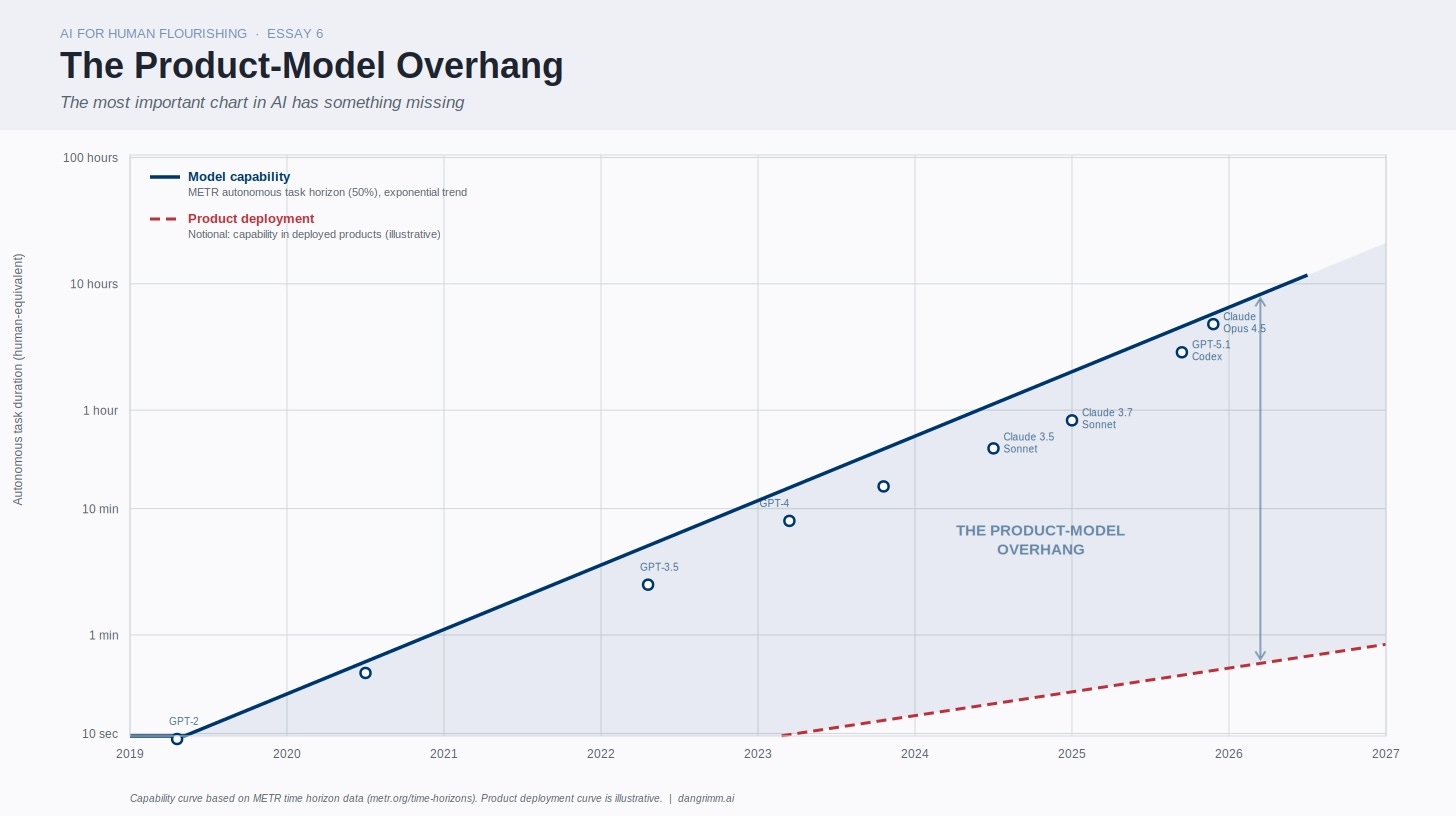
METR’s autonomous task horizon is the best empirical measure we have of what AI systems can actually do: not what they score on benchmarks, but how long they can think and act on a real problem. The tasks are concrete: debugging a codebase, writing and testing software, conducting research across multiple sources. That horizon has been doubling every four to seven months since 2019. Frontier models now sustain useful work for roughly 14 hours without human intervention.¹ The curve is exponential and shows no sign of flattening.
But something is missing from the chart. There is no second curve showing product deployment. No line tracking how much of that capability has been put to use in the form of products with usable interfaces, access to data, tool-calls, identity, connectivity, etc. that solve real users’ problems. If you drew one, the gap between the two would be enormous. That gap is a product-model overhang. Model capability is the latent resource. Product is the bottleneck.
The overhang is measurable
Anthropic’s Economic Index, published earlier this year, puts numbers on the overhang from a different angle. Their researchers measured what AI can theoretically do across occupations and compared it to what is actually being deployed. The theoretical coverage is striking: 94.3% of tasks in computer and math occupations, more than 80% across most knowledge work. The observed deployment is a fraction of that. Anthropic’s own framing is direct: as capabilities advance and deployment deepens, the gap will close. But right now, the red area on their chart (what’s deployed) is far smaller than the blue (what’s possible).²
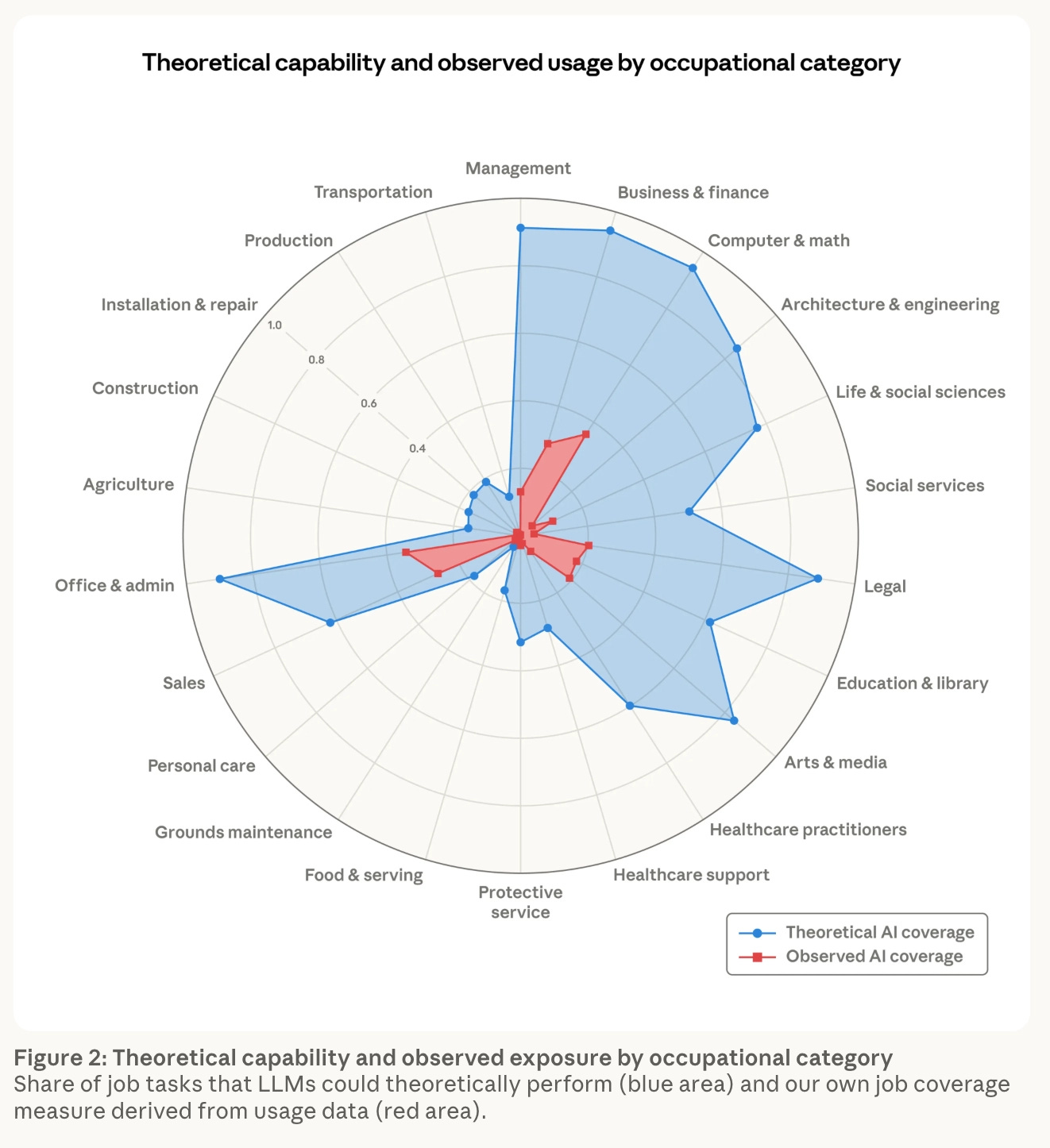
Two independent measures, same conclusion. The models have outrun the products built on top of them.
What this looks like in practice
In November 2025, an Austrian developer named Peter Steinberger published a weekend project called Clawdbot. It was a way to text an AI agent and have it actually do things on your behalf: manage files, coordinate tasks, execute actions through WhatsApp, Telegram, Slack, and dozens of other messaging platforms. The underlying model capabilities (Claude 3.5 Sonnet, GPT-4) had existed for 18 to 30 months. Nobody had built the right product wrapper.
Within 60 days, the project (renamed OpenClaw after an Anthropic trademark complaint) crossed 250,000 GitHub stars, surpassing React’s decade-long record. It is now the most-starred software project on GitHub. Steinberger was hired by OpenAI. The project moved to an independent foundation.³
The models were ready. The product layer was the binding constraint. One builder collapsed the overhang for developers.
I saw the same pattern from the inside at AT&T. My team built a voice AI agent, a digital receptionist that answers your calls and takes action based on your preferences.⁴ The model capability existed >12 months before we shipped. What took time wasn’t the AI. It was the network integration, the identity layer, and the UX to make it work on any phone. That work is the overhang being worked off.
Why the gap persists
Capability recognition requires proximity to the technology that most budget-holders don’t have. You cannot commission the product you cannot imagine. Organizational learning lags model releases by 12 to 24 months, and the gap compounds. BCG quantifies the structural version of this with its 10-20-70 rule: algorithms account for 10% of AI transformation effort, technology and data another 20%, but people, process, and organizational change account for the remaining 70%.⁵ The overhang lives in the 70%. OpenClaw collapsed the imagination gap for developers, which is partly why it grew so fast. The equivalent hasn’t happened yet for most industries.
The objection here is that the real bottleneck isn’t product imagination but regulation, enterprise procurement cycles, and trust. That’s real friction. But it’s downstream of the product problem: you can’t get procurement to approve what hasn’t been built yet.
Agents are products too
The next wave makes this more urgent, not less: agent systems and the Model Context Protocol (MCP) are expanding the product design surface area while simultaneously commoditizing the data advantages that SaaS incumbents relied on as moats. More on that in the next essay.
For now, the picture is clear. The models are doing their part. Anthropic is putting capital behind closing the gap, including a reported $200M partnership with PE investors to accelerate deployment.⁶ The question for builders is not “when will the models be ready.” They are. The question is who will do the product work to close the gap, and whether they’ll build for the people who need it most.
Dan Grimm writes AI for Human Flourishing, a weekly Substack on what it means to build AI that serves people, not the other way around. He previously led new product development at AT&T, built SAFR by RealNetworks, expanded Amazon Kindle around the world, and co-founded a few startups.
Footnotes
¹ METR, “Autonomous Task Horizons.” Frontier model task horizons doubling every 4-7 months since 2019. metr.org/time-horizons
² Anthropic, “Labor Market Impacts of AI: A New Measure and Early Evidence,” March 2026. Figure 2: Theoretical capability and observed exposure by occupational category. anthropic.com/research/labor-market-impacts
³ OpenClaw blog, “250,000 Stars,” March 4, 2026. See also Wikipedia, The New Stack, and Medium coverage. Originally named Clawdbot (November 2025), renamed after Anthropic trademark complaint. Creator Peter Steinberger hired by OpenAI (announced by Sam Altman on X, February 2026). Currently at 347K+ stars. openclaws.io/blog/openclaw-250k-stars-milestone
⁴ See “Your Phone Number Is an AI Address,” AI for Human Flourishing, Essay 4. writing.dangrimm.ai/p/your-phone-number-is-an-ai-address
⁵ BCG, “Scaling AI Requires New Processes, Not Just New Tools,” January 2026. bcg.com/publications/2026/scaling-ai-requires-new-processes-not-just-new-tools
⁶ Wall Street Journal, “Anthropic in Talks to Invest $200 Million in New Private-Equity Venture,” April 6, 2026. wsj.com/tech/ai/anthropic-in-talks-to-invest-200-million-in-new-private-equity-venture