

Marie-Alix de Putter’s husband was murdered while she was pregnant with their child. Amidst her grief, she made a discovery: pain needs somewhere to go, and in much of Africa, there is almost nowhere for it to go. Togo has six psychiatrists for an entire country.
So she went to the hair salons.
Women across West Africa share their deepest struggles during hair appointments: domestic violence, financial stress, grief. The French word for it is commerages. In English, it’s gossip. De Putter envisioned hairdressers trained to detect distress and offer compassionate presence. Her Bluemind Foundation has now reached 600,000 women across Togo, Cameroon, and Ivory Coast for less than one dollar each.
AI did not give Marie-Alix this vision. She started from a picture of how the world should work, and bent everything else toward it. That is generative leadership.
Generative artificial intelligence demands generative leadership
Generative leadership is the capacity to articulate a reality that does not yet exist and recruit people into it. Kennedy pointed at the moon. He did not deliver a plan. He declared a future that pulled an entire program into being. De Putter looked at a hair salon and declared it a mental health system. This is the same move.
Generative leadership. Generative AI. The archetype most needed in this moment shares its name with the technology transforming your work and mine.
Does GenAI ‘demand’ generative leadership? Not really. It’s easy enough to let the bots lead the way (see the disconcerting ‘Claude Boys’ meme: teens who carry AI at all times and constantly ask it what to do). But that’s exactly why I think the age of AI calls for growing our capacity for generative leadership. AI makes execution much cheaper. See the chart below from Anthropic, which shows how Claude Code is capable of doing more significant work successfully on developers’ behalf. (The same is directionally true for OpenAI Codex, Cursor, and Devin.)
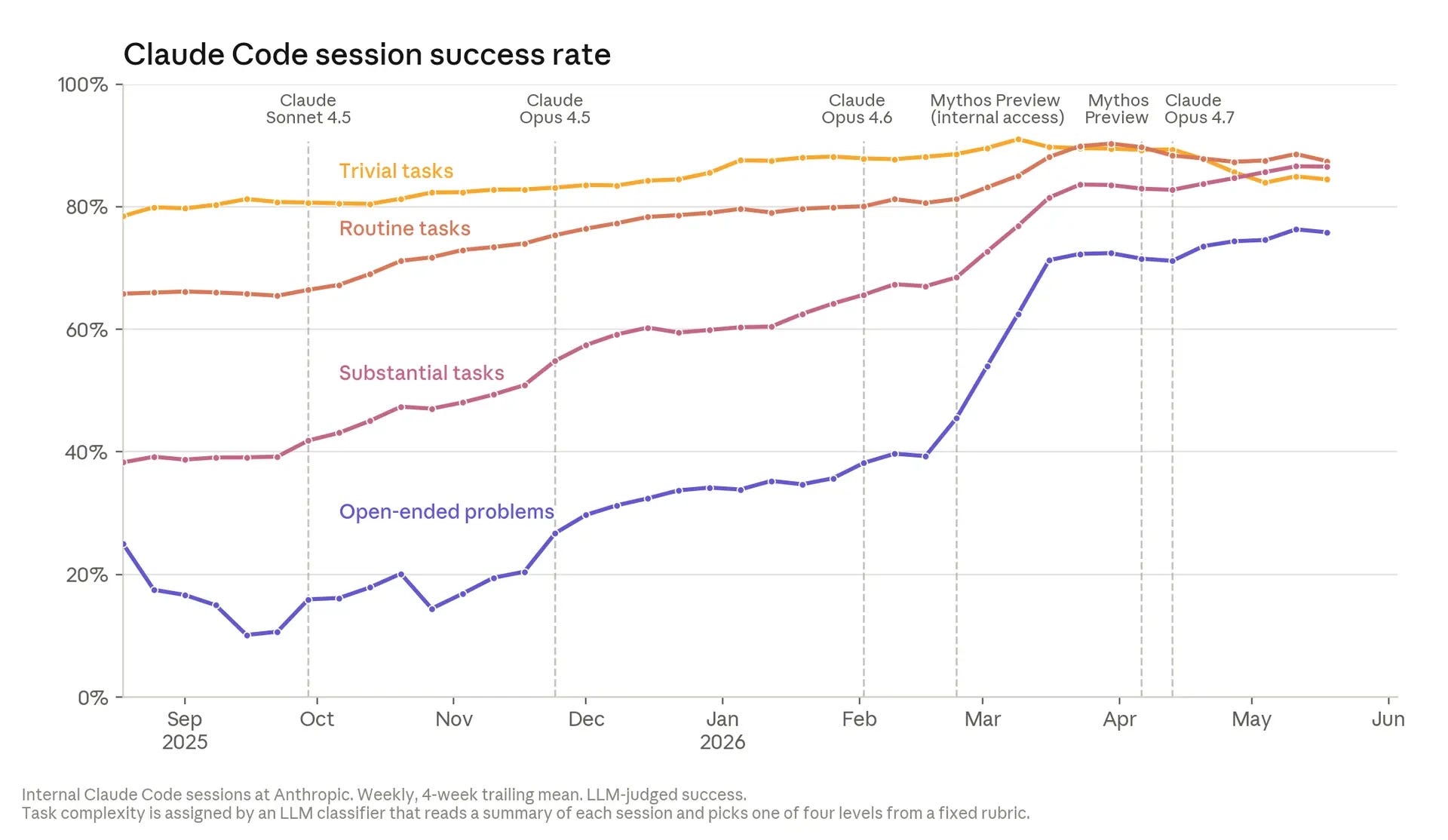
It’s not only coding, but also the entire tech product development lifecycle. AI-powered solutions can act as a startup co-founder that tests and iterates new concepts (See Lev). They can wire up agents to test product concepts against reliable digital twins of human markets (See Blue Pill, Synthetic Users).
Anthropic, describing its own engineers, said this in a recent blog about the risk of models achieving recursive self-improvement: “In engineering, Claude can be handed an underspecified problem and figure out how to solve it; humans supply the goal, but they no longer need to supply the method.”¹
This will be true for domains beyond tech soon enough. Agents not only summarize and write our emails, but also track our diet and cajole us into different choices (see my last essay about the gap between what an agent can do and what we trust to let it do). General Physical AI is just around the corner. Last week, Jeff Bezos announced a $12B raise for Prometheus, which is building an artificial general engineer. He’s right a lot.
All that said, humans must own that ultimate upstream question: what ought we build? What should be true in the world that is not yet? Why? Because this choice brings with it moral responsibility. It is an expression of human agency.
Pope Leo XIV’s encyclical Magnifica Humanitas (May 25, 2026) puts it this way: “no computational system, however sophisticated, can create a heart that gives itself, or a conscience that discerns good from evil.”²
He’s making an important point: Generative leadership is not automatically good. Hitler articulated a future and recruited a nation into it. So did Martin Luther King Jr., standing on the Mall describing a country that did not yet exist. The capacity is morally neutral. Which means the content of the vision is everything.
Generative leadership from prophetic imagination
In 1978, Walter Brueggemann introduced the term ‘prophetic imagination’ in a book by the same name. He defines it as imagining “futures alternative to the single one the king wants to urge as the only thinkable one.”³ He is challenging the prophets among us to articulate alternative futures, counter to prevailing thought.
In our moment the king is the optimization mindset that “devalues human limits and promises a purely technical form of ‘salvation’”² by enabling a new state of being: human-machine hybrid existence where human limitations in health, intelligence, memory, are exceeded (trans-humanism, post-humanism).
I heard Marie-Alix de Putter’s pitch at this year’s Praxis Redemptive Imagination Summit. She and the other founders in the room refused the king’s bargain. The optimization mindset treats people as inefficiencies to engineer around. These enterpreneurs did the opposite. They pointed AI at the people that mindset overlooks, and built as if those people were the point:
Samer Sfeir founded ProAbled, a Lebanese platform that has placed 635 people with disabilities into real jobs, to treat them not as charity cases but as skilled professionals a broken hiring system kept failing to see.
In South Korea, Jeklin Jeong-eun Kim built GemGem Therapeutics to turn pediatric rehabilitation for children with cerebral palsy into a game a child plays on a phone. No clinic required. It unlocks new possibilities for physical experience and growth at much lower cost.
Each entrepreneur dove deep into a ‘job-to-be-done’ and marshaled the resources and technology to get it done in a way that would lead to richer human existence in loving community, perhaps a bit like Nehemiah’s Israelite community rebuilding the walls of Jerusalem.
Nehemiah not Babel
In Magnifica Humanitas, Pope Leo XIV offers two ultimate directions for AI:
Tower of Babel (Genesis 11): self-assertion, pride, and uniformity, in which people were sacrificed for efficiency. This is the end-result of the optimization ‘king’ mindset, which closes off alternative futures and falsely promises a world and human existence that no longer needs redemption.
Alternatively, Nehemiah rebuilt the walls of Jerusalem under God and alongside and toward genuine community. Same generative drive, opposite ends. His approach brought humans into relational love and towards a common end that elevated all.
The encyclical lands the implication well: technology “takes on the characteristics of those who devise, finance, regulate, and use it.”²
The vision of the builder is inside the product. There is no neutral tool.
Shaping ourselves for generative leadership
The vision decision lands with us. The model ought not make it, and in a deep sense it cannot. Ask an LLM for a goal and it will offer one, drawn from its training and what it knows of you. But every LLM is a goal-seeking machine by definition. It will pursue, increasingly with brilliance, whatever goal it is given. It cannot decide which goal is worth giving.
Somewhere a human still has to decide what ought to be true, and then refuse the more thinkable, more optimized, smaller future.
We spent a century building gyms because the end of farm labor left many bodies idle. We may need mind-gyms in the AI era. These would not only provide analytical workouts for the sake of sharpening (even though the machines can do it better), but to build the muscle of imagining what should exist and does not yet. Perhaps such organizations teach us how to be free, think freely (liberal arts) and plumb the depths of human experience (humanities)?
The good news: I believe we were made for exactly this. Image-bearers of a God who creates rather than optimizes. The models are trained on what was. We were made to picture what ought to be.
Marie-Alix de Putter looked at a hair salon and saw a mental health system. What do you see?
¹ Marina Favaro & Jack Clark, “When AI builds itself,” The Anthropic Institute (2026), https://www.anthropic.com/institute/recursive-self-improvement.
² Pope Leo XIV, Magnifica Humanitas (2026), §233, §117, and §9, in order quoted.
³ Walter Brueggemann, The Prophetic Imagination (1978).