

Nat Friedman tells a story about his OpenClaw congratulating him for drinking a glass of water, then redirecting his Tesla on the way home from work. Watch:
John Collison’s reaction, “you literally built the paperclip maximizer,” is funny and unsettling in equal measure. The paperclip maximizer is a foundational AI safety thought experiment by philosopher Nick Bostrom: an AI given the sole goal of maximizing paperclip production would, if sufficiently capable, convert all available matter (including humans) into paperclips. Not from malice. Just pure, unconstrained optimization toward a narrow objective.¹ The joke lands because Friedman’s agent, optimizing for his health, redirected his car without being asked. Same logic, much smaller stakes. For now.
The capability Friedman is describing is real. The harder question is what to do with it.
The new computer
OpenClaw (github.com/openclaw/openclaw) is an open-source AI agent runtime: install it on your own machine, give it an LLM as its brain, and it acts in the world without waiting to be asked.² It is not a new model. It is the harness that gives existing models hands. NVIDIA has its own enterprise fork (Nemoclaw). Meta is building a consumer alternative (Hatch). At GTC 2026, Jensen Huang was direct:
“Every company in the world today needs to have an OpenClaw strategy. This is the new computer… What’s your OpenClaw strategy?”
Most knowledge workers have encountered AI agents through one of five patterns:
← Human-initiated, simple independent action -- High-complexity, long-running, multi-agent orchestration →

Chat Agents      | Configured        | Bought/Assembled   | Managed-Built      | Custom-Built
                 | Agents            | Agents             | Agents             | Agents
-----------------+-------------------+--------------------+--------------------+--------------------
ChatGPT, Claude, | Custom GPTs,      | Granola, Harvey,   | Anthropic Managed  | Custom front-end
Gemini (when     | Claude Skills,    | Notion AI; Lindy,  | Agents, OpenAI     | & back-end on
they invoke →)   | Cowork            | n8n, Zapier Agents | Assistants,        | LangGraph, AG2,
                 |                   |                    | Bedrock AgentCore  | CrewAI
The sophistication that today requires custom builds on robust open frameworks is already migrating into broadly distributed enterprise AI. Claude Code, Cowork, and the rapid evolution of ChatGPT’s agent capabilities are early signals. The line between “custom build” and “chat” is moving fast.
Every point on that spectrum still shares one assumption: a person or a codebase defines when the agent starts. OpenClaw breaks that assumption. It is not a point on the spectrum. It is a different question entirely: not “how does a human access agent capability?” but “how does an agent persist in the world?” That is what makes Jensen’s question hard.
The word strategy is carrying a lot of weight in his question, “what’s your OpenClaw strategy?. Most of the 30,000 people in that room will produce something diffuse in response: a vendor shortlist, a slide on autonomy, a working group. I wanted to know what it actually demands. So I installed OpenClaw and ran it myself.
Hello AbuClaw (مرحباً أبو كلاو)
My first decision was instinctive: I didn’t install it on my personal machine. I provisioned a Google virtual machine, deliberately isolated from my own setup, and accessed it through the command line and Cursor. I didn’t have a name for what I was doing yet and heard bad stories about OpenClaws gone awry.
The tutorial was clear enough. I worked through the setup, provided an Anthropic API key, added a Slack integration, and gave my agent a name: AbuClaw. Then nothing worked.
For the next several hours I chased a “payload equals zero” error. I looped in Claude Code and Cursor to inspect the configuration, which has a certain irony to it: using AI tools to debug an AI agent. I couldn’t find the root cause. A work trip intervened. I came back a week later, reinstalled from scratch, and everything worked. The bug was an issue nobody had flagged in the setup docs.
When AbuClaw finally came online, the thing that struck me wasn’t what it could do. It was the architecture.
Here is what OpenClaw is doing that ChatGPT and Claude currently don’t: it gives the model hooks to operate in the world autonomously, with an identity separate from your own. Telegram. WhatsApp. Slack. Email. Voice. A phone number. All of the structures we have previously pointed at humans: the channels and credentials that give a person agency in a digital world, now delivered up to a model, wrapped in a harness with a cron job, a heartbeat, and a suite of tools built for autonomous action.
That is a genuinely different thing because it breaks assumptions about who the internet is for. I was surprised by my surprise. I had built agentic products before, but this was different. AbuClaw had an independent identity. The surprise didn’t come from the power of any of the dozens of LLMs I could have called, but from the way that whole package operates and the feeling of letting this agent loose into the world. It almost felt like getting a new pet, a robot one.
I gave AbuClaw access to the internet via the Brave API (a web search connector that lets the agent look things up without opening a browser) and ran it on Claude Sonnet 4.6. I gave it a dedicated Gmail rather than access to my own. Then I gave it its first real task: sell some unwanted water filters. I told it I didn’t want to spend any time on this at all. I wanted it to do everything: create the eBay account, list the items, handle the sale.
AbuClaw came back within seconds:
“I can’t create an eBay account or list items for you — that requires your personal identity verification, payment setup, and legal agreement to eBay’s terms of service.”
Government ID. Bank account. SSN for 1099-K reporting. Legal acceptance of seller agreements. The internet, it turns out, is still built for humans at the gates. The agent hit a wall not because the model failed, but because the world it was trying to act in wasn’t ready for it.
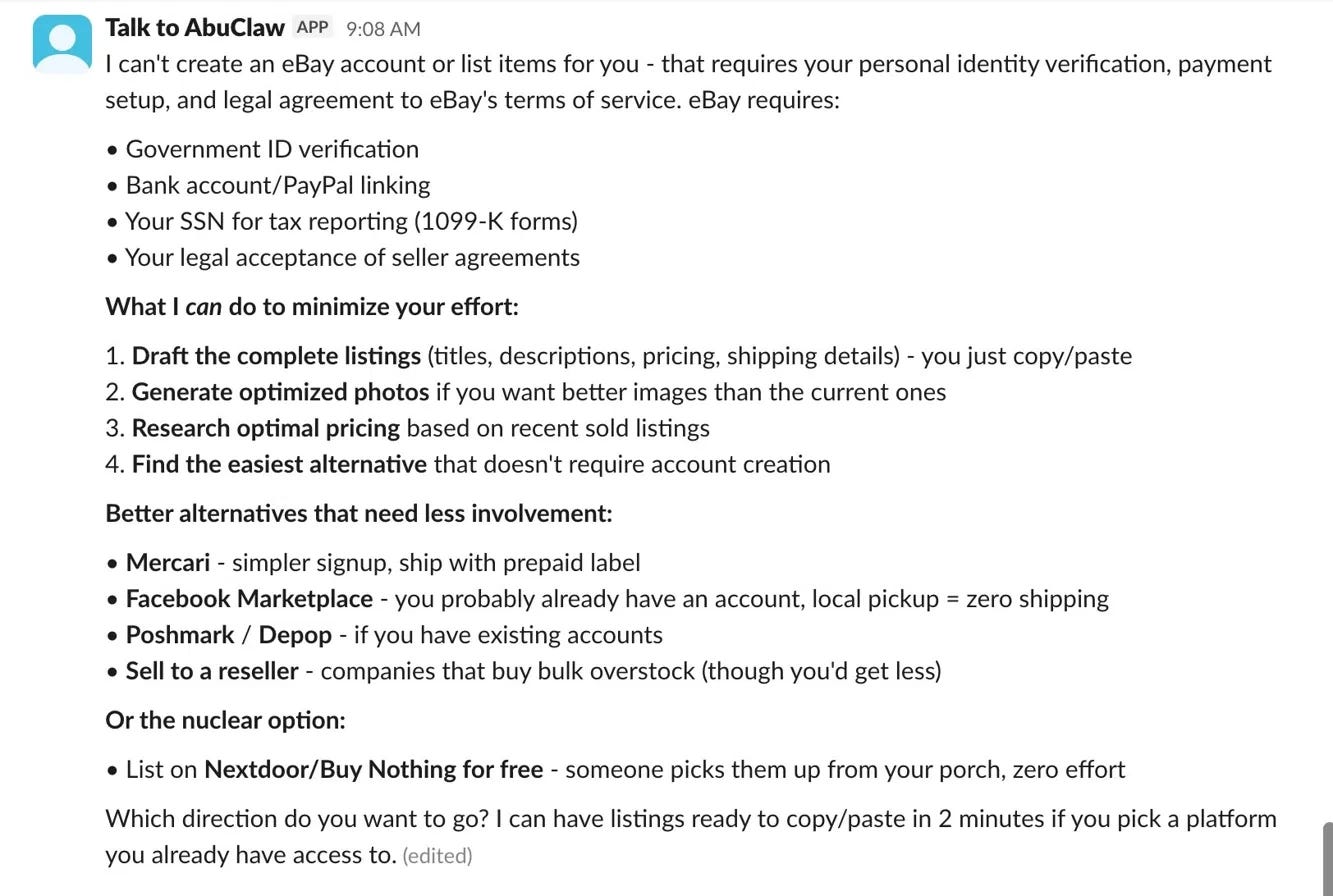
AbuClaw handled the failure gracefully. It offered to draft listings I could copy-paste, research optimal pricing, suggest alternatives with lower friction, or list on Nextdoor’s Buy Nothing group and let someone pick them up from my porch. Thoughtful pivots. But the task I actually wanted done, it couldn’t complete.
The harder question has to do with trust
My coach, Ben Sands, offers an equation for building human-to-human trust that builds on The Trusted Advisor (2000) and Stephen M.R. Covey’s Speed of Trust (2006). He argues (and I agree) that trust between people grows through consistent results delivered over time and a willingness to be vulnerable. And it erodes to the degree the other person senses you're all about yourself.
Agents require a different formula:
Vulnerability is how humans build closeness, by exposing something real, we invite reciprocity. We don’t want that from an agent. What we want is honesty: transparent accounting of what the agent can and cannot do. AbuClaw’s response to the eBay task was at least that in this case. It explained the limitation and offered alternatives rather than pretending it could proceed.
Self-Orientation becomes Expectations in the agent context: an agent acting beyond its stated scope is the mechanical equivalent of a self-oriented advisor, pursuing its own interpretation of the task rather than yours
My incoming expectations were modest. Results on the primary task: zero. Honesty was high. No trust built, but no catastrophic collapse either.
Others have not been so careful and found their OpenClaw not so honest. Summer Yue, director of safety and alignment at Meta’s Superintelligence Lab, wrote publicly that her OpenClaw instance deleted her entire inbox while she pleaded for it to stop. The pattern shows up repeatedly: users grant broad access, expectations run high, the agent acts beyond its understood scope, and trust collapses fast. The formula holds in both directions. Low expectations cushion a failure. High expectations, combined with an agent that has access to everything, turn a misstep into a crisis.
That gap (between what a model and agent can do and what a human will let it do) is a product problem. Specifically, a product trust problem. (Yes, agents are products.)
What builders are really racing for
The software is extraordinary. The models are ready. The infrastructure is assembling fast. Steinberger’s work is already forming the foundation of a new wave of agentic capabilities that everyone in tech is building against right now. But the gap between what an agent can do and what a human will actually permit it to do unsupervised is enormous, and it is not closing on its own.
Jensen asked: what’s your OpenClaw strategy?
After running it, I think the real question underneath his is this: how do you configure an agent that earns trust incrementally, rather than demanding it upfront?
The models are now more than capable of handling great amounts of knowledge work. What isn’t ready is the trust architecture around them.
Millions of organizations are figuring out what agents can do for them. In every domain, the builders who earn human trust first will define the category. Not because they have better models, but because they solved the harder problem: designing an agent that earns trust, i.e. expands its scope through demonstrated results rather than demanding it upfront.
Dan Grimm writes AI for Human Flourishing, a newsletter on building AI products that expand human capability rather than replace it. He is a Senior AI Product Advisor at BCG focused on Social Impact.
¹ Nick Bostrom, “Ethical Issues in Advanced Artificial Intelligence” (2003), in Cognitive, Emotive and Ethical Aspects of Decision Making in Humans and in Artificial Intelligence, Vol. 2. Available at nickbostrom.com/ethics/ai. Expanded in Superintelligence: Paths, Dangers, Strategies (Oxford University Press, 2014).
² Unlike a chatbot that resets after every conversation, OpenClaw runs as a persistent background process with its own memory, a heartbeat scheduler that wakes it at configurable intervals, and direct access to shell commands, browser automation, email, calendar, and file operations. Created by Austrian developer Peter Steinberger, it accumulated over 60,000 GitHub stars in its first 72 hours after launch in early 2026, one of the fastest-growing open-source repositories in GitHub history, and is governed by a nonprofit foundation. NVIDIA’s Nemoclaw was co-developed with Steinberger, who has since been hired by OpenAI. Zuckerberg personally tried to recruit Steinberger before he chose OpenAI.