

While everyone in tech talks about lobster-themed robots that call you, something consequential is happening inside the world’s largest telephone networks: mobile carriers are building AI directly into the network itself.
Last year, AT&T announced an AI to answer your phone calls that my former team and I built.1 Last month, T-Mobile announced a service that translates calls in real time into 50+ languages.2 Both run inside the network, not on the device. And one of them requires no app at all.
The Network Wakes Up
In early 2024, two innovators on AT&T’s new product squad pitched me an idea: embed AI directly into the network so it could act on a customer’s behalf.
We envisioned a platform that went beyond call screening. As AT&T’s Chief Data Officer Andy Markus described in AT&T’s announcement last year, phone-number associated AI agents could eventually handle tasks like booking reservations and managing appointments autonomously, with the network as the platform.3 A world where personal AIs talk to business AIs and business AIs coordinate with each other. We called that vision a Web of AIs.
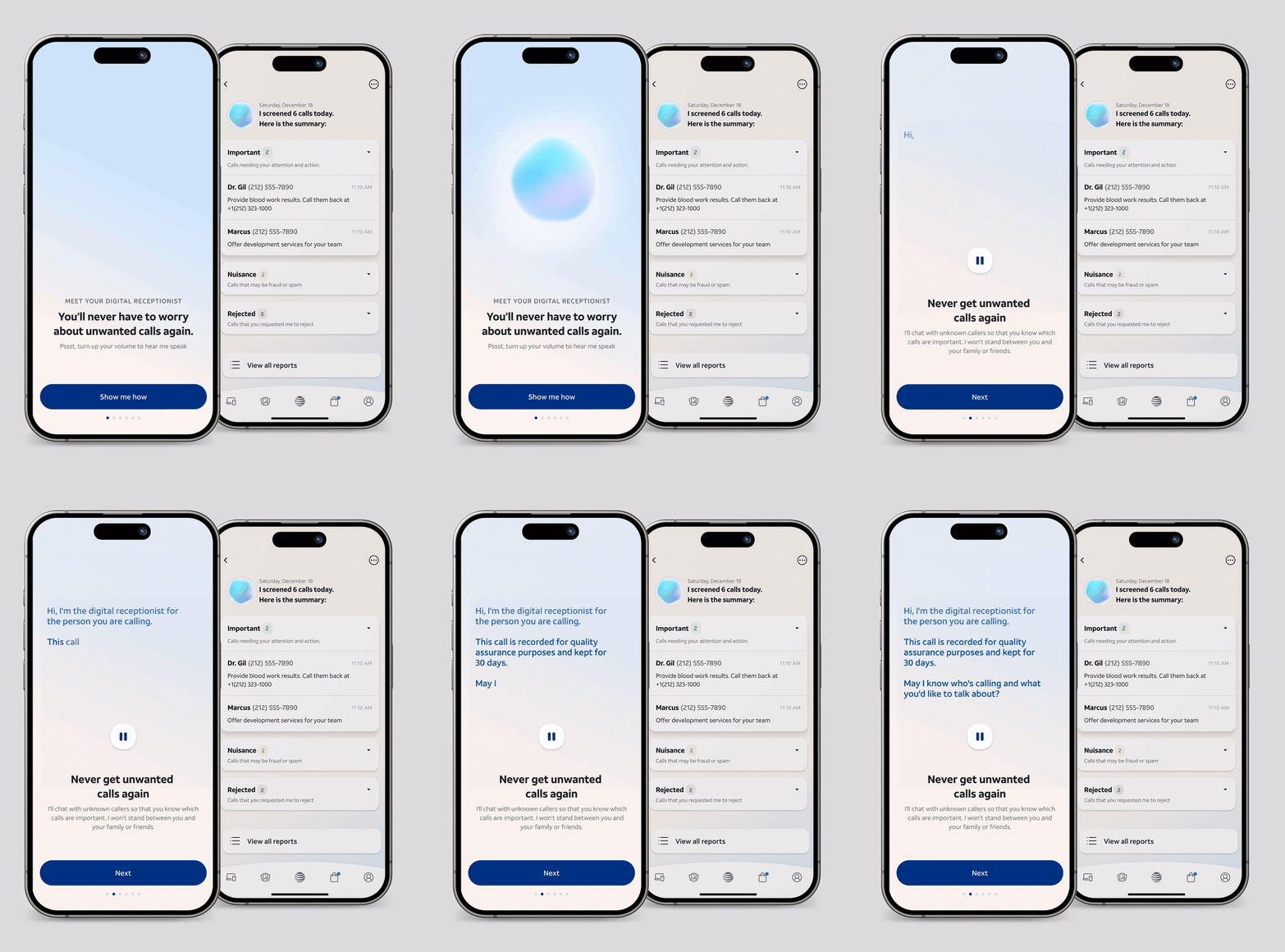
The web of AIs (or agents as we’ve learned to call them — the apps of the AI era) is certainly now emerging. AT&T’s Digital Receptionist, now in testing, was a first for telcos.4 It answers incoming calls, determines intent, and takes independent action based on user preferences. It runs in the network so it works regardless of handset; you use a companion app to configure preferences and review transcripts.
Last month, T-Mobile announced Live Translation, which also runs entirely in the network layer, but does not require an app or download or account setup. Press 87 during a call and the network translates between 50+ languages in real time. Coming soon in beta, it works on any phone on the network, including when the other party is on a landline.5
The T-Mobile announcement (and a new role that I’ll share soon), got me thinking about the true potential for network-embedded AI. I think its greatest potential may be found in lower income countries around the world.
Why the Network Layer Matters
AT&T demonstrated that a telephone network’s IMS core can host agentic AI. T-Mobile will demonstrate that it can operate with zero user-side software. Each is a point on a spectrum: on one end, rich app-assisted AI agents; on the other, invisible services activated by a keypress, accessible to anyone with a phone number.
That second end of the spectrum is where the opportunity lives for low and middle income countries. Populations that are slow to adopt apps, or who struggle with unfamiliar ones, are underserved. Carrier reach is not device reach. Apple Intelligence serves whoever bought the latest handset. Network-based AI serves everyone on the network: 5.6 billion unique subscribers globally.6
The trust and identity layer that the open web never built? Carriers already have it.7 For folks interested in bringing AI services to the most vulnerable, the best path forward is not asking people to adopt a new interface. It is embedding AI into the surfaces they already trust.
At MWC26 Barcelona this week, GSMA Director General Vivek Badrinath described carriers as the “foundational layer of the AI stack” and warned that if people cannot use AI in the language they speak, they are excluded from the opportunities it creates.8 The data from Africa shows exactly where that exclusion concentrates.
Follow the Phone Number
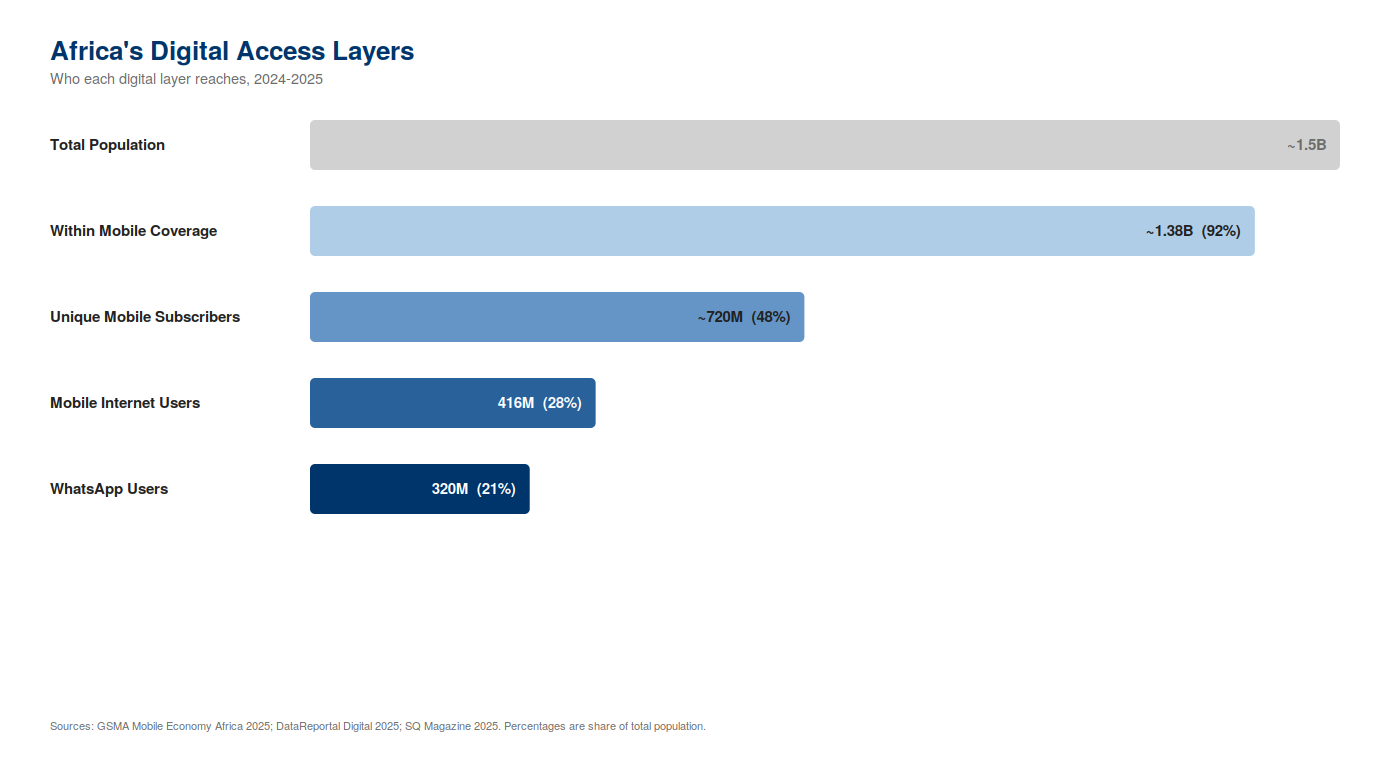
Africa has 416 million mobile internet users at just 28% penetration. 960 million more people live within mobile coverage but do not use mobile internet.9
Consider Rwanda, where the Gates Foundation and OpenAI announced it would begin “Horizon 1000”: a $50M initiative to deploy AI across 1,000 primary health clinics by 2028.10 At Davos, Gates described patients accessing free AI via text or voice, even when not at the facility.11 It is an exciting vision, backed by convincing studies that suggest it can help address a major shortage of healthcare workers. But 85% of Rwandan households own a mobile phone while only 34% own a smartphone.12 Internet penetration is just 34%.13 How do you deliver the promise for those who need it most?
You deliver it via their phone number. Across the continent, the phone number represents your wallet, too. Sub-Saharan Africa has 1.1 billion registered mobile money accounts, two-thirds of the global total, contributing roughly $190 billion to African GDP in 2023.14 In Kenya alone, the central bank now classifies M-Pesa as systemically important financial infrastructure, processing over $650 billion in transactions in 2025.15 Much of this still runs on USSD (the text-based menu system behind mobile money and airtime top-ups) and SMS.
For those who can afford mobile internet, WhatsApp is the way to reach them. More than an app, WhatsApp often IS the internet for that population. And it affords conveniences that app-habituated US users might envy. When I was in Kenya last year, I was delighted to find that I could WhatsApp a pharmacy at 2 AM, get excellent (human) advice on the right meds for my child’s GI distress, pay over M-Pesa, and have then delivered to my door by 4 AM — no additional logins. WhatsApp has 320 million African users, with penetration above 90% of internet users in Nigeria, Kenya, South Africa, and Ghana.1617
However, for the other 960 million not on mobile internet / WhatsApp, voice and USSD remain the digital surfaces. Any AI strategy that relies solely on apps misses the people who need it most. Pioneering services have already proved the potential:
In Kenya, Jacaranda Health’s PROMPTS platform delivers AI-powered maternal health guidance to 3 million mothers via two-way SMS, at less than $1 per mother. A Harvard-led RCT showed it doubled postpartum family planning uptake and increased postnatal check-ups by 25%.¹⁷ No app. No data plan. Just a phone number.
In India, ARMMAN’s Kilkari program reaches over 60 million women across 27 states through automated IVR voice calls timed to gestational age. A predictive model developed with Google DeepMind reduced dropout among high-risk women by roughly 30%, and an RCT showed a 20% increase in prenatal visits and 48% increase in exclusive breastfeeding.18
The pattern is the same: phone number as identity, existing surface as interface, AI hosted in the cloud or on the network.
What Comes Next
My team at AT&T invested in embedding AI inside the IMS core. Ambitious mobile network operators in low and middle income countries may choose that route, but there’s an even easier path for others: build a platform layer on top of carrier identity infrastructure and APIs that makes the phone number a first-class AI endpoint. At MWC26 Barcelona this week, GSMA demonstrated agentic AI agents orchestrating tasks through Open Gateway’s network APIs, a step toward exactly that kind of programmable platform.19
It’s harder than it needs to be for players like Jacaranda Health and ARMMAN to deliver these kinds of services. And, there’s great potential to make it simple to wire such AI services up with other useful building blocks: identity infrastructure through MOSIP, now adopted by 26+ countries20, payment rails that move hundreds of billions, and — of course — messaging and voice that reaches almost everyone. What’s missing is the connective layer that lets many more developers and governments deploy AI services to any phone number as easily as they build a web app.
Whether carriers build this platform layer themselves, or open it to others through APIs, the phone number is already the most inclusive digital identifier in most countries. The question is who is going to assemble the rest of the stack and make it easier for more of these services to succeed?
I think Bill Gates is right: AI holds massive potential to improve many lives and has to be available in their own language, wherever they are. For folks in high-income countries, the interface will probably be an agent paired with a new app. For hundreds of millions at the bottom of the economic pyramid, the best access point is simpler: a phone number they already have.
Dan Grimm writes AI for Human Flourishing, a weekly Substack on what it means to build AI that serves people, not the other way around. He previously led new product development at AT&T, built SAFR by RealNetworks, expanded Amazon Kindle around the world, and co-founded a few startups.
AT&T, “Tired of Screening Spam Calls? An AI Digital Receptionist Could Do It for You,” September 16, 2025. The product is currently in testing with select customers. Link
T-Mobile, “Live Translation,” 2025. Network-level real-time translation in 50+ languages, no app required. Link
Andy Markus, AT&T Chief Data Officer, described the broader vision: "This is just a taste of what AI agents could do with your phone to make your life easier. Eventually, a future AI agent could autonomously connect you to make reservations at the hottest restaurant." Link
See also coverage in The Verge and Mobile World Live.
The Verge, "T-Mobile Live Translation turns your phone calls into real-time multilingual conversations." Activated by pressing 87 mid-call. Works on any T-Mobile network phone, from flip phones to smartphones. Link
GSMA, "The Mobile Economy 2025." 5.6 billion unique mobile subscribers globally.
GSMA Open Gateway. As of MWC26 Barcelona (March 2026), 86 operator groups representing more than 300 networks and approximately 80% of global mobile connections. Updated from 73 operator groups at H1 2025. Link
Communications Daily, "GSMA Focused on 5G Stand-Alone and AI as Mobile World Congress Starts," March 2, 2026. Badrinath described carriers as the "foundational layer of the AI stack" and warned: "If people cannot use AI in the language they speak, they're excluded from the opportunities it creates." Link
Gates Foundation and OpenAI, "Horizon1000," announced at the World Economic Forum, January 21, 2026. OpenAI | GatesNotes
Sara Jerving, “Low-resource nations may leapfrog wealthier ones in using AI for health,” Devex, January 22, 2026. Gates described ensuring patients have access to free AI in their own language, even when not at the facility. Devex | WEF Panel Video
Rwanda National Institute of Statistics (NISR), Integrated Household Living Conditions Survey (EICV7), April 2025. 85% mobile phone ownership, 34% smartphone ownership. The largest gains in mobile ownership were among the poorest households. Link
TechCabal, “M-Pesa has become too big for Kenya to fail,” January 28, 2026. In 2025, M-Pesa processed transactions with an economic value of KES 83.7 trillion (~$650 billion). Kenya’s central bank has classified M-Pesa as systemically important financial infrastructure. Link
Sources: DataReportal Digital 2024/2025 country reports; SQ Magazine WhatsApp Statistics 2025.
Jacaranda Health, “PROMPTS.” Two-way AI-powered SMS chatbot delivering personalized maternal health guidance. 3M+ mothers across Kenya, Ghana, Nigeria, and Eswatini at less than $1 per mother. Harvard-led RCT showed 2x increase in postpartum family planning uptake and 25% increase in postnatal check-ups. Link In 2024, Jacaranda launched UlizaMama, a custom LLM for multilingual maternal health Q&A in Swahili and English.
ARMMAN, “Kilkari” and “mMitra.” Kilkari is implemented with India’s Ministry of Health and Family Welfare across 27 states, reaching 60M+ women via automated IVR voice calls. The predictive ML model, developed with Google DeepMind and IIT Madras (Harvard TEAMCORE RMAB algorithm), reduced dropout ~30% among high-risk women. A peer-reviewed RCT showed 20.3% increase in prenatal visits and 48.5% increase in exclusive breastfeeding, a critical global health intervention to reduce infant mortality. Link